


A consensus on the need to replace fossil fuels with renewable energy sources has been reached with most countries around the world pledging to ensure carbon neutrality by 2050. This will involve reducing emissions CO2 and expanding the proportion of renewable energy sources such as rechargeable battery systems, such as Li-ion batteries which have received great attention from industry and academia. Still, the challenges of developing the next generation of LIBs with enhanced performance remain due to the limited performance of the devices currently in use. Her Ph.D. In research, Ming Jiang looked at the design of electrode objects and the reduction methods of nickel-based cathode batteries.
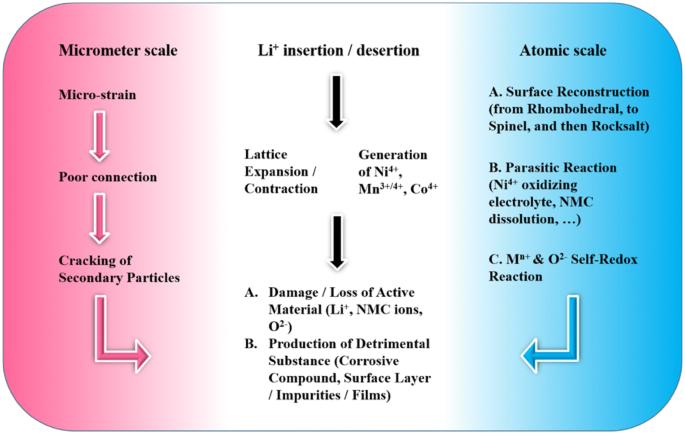
The strain on increasing the energy density of Li-ion batteries (LIBs) is the cathode material of the battery. For example, Ni-rich (nickel-rich) transition metal oxides have a very high energy density but suffer from poor cycling stability. The instability of the Ni-rich cathode based on LIBs is related to the different indirect reactions that occur within the batteries.
Material enrichment strategies can reduce these side effects. Her Ph.D. In research, Ming Jiang considered the design of electrode objects and the degradation methods of Ni-hodan cathode-based batteries. Ni-hodan NCM cathodes and Li-metal anodes with high battery performance are achieved through these new optimization strategies. The corresponding reduction events are investigated, and detailed methods are identified.
Jiang designed Ni-rich catalysts with a nanostructure structure. With this design, battery stability and Li-ion vehicle mobility have been enhanced through a unique production process. The extra features ensure a high exposure ratio for specific crystals phases, which is beneficial for Li-ion diffusion and optimal structure during cycling. In addition, the improved instantaneous loading capacity has also been realized due to its well-designed structure, which suggests the effective capacity of the proposed product.
In addition to the combination of new substances, Jiang investigated the negative effects of battery systems as this is important for promoting the development of LIBs. Many indirect reactions occur simultaneously in the battery, such as dissolving the cathode, forming a hard-electrolyte-interphase, and a small crack. The reaction cells consume Li-ions and active electronics, which eventually causes the battery power to decompose.
Each component of a battery system may participate in indirect reactions, including electrical components, connectors, carbon dioxide, and other additives. However, it is difficult to separate each component during the post-mortem study on standard battery configuration. Therefore, Jiang proposed a thin-film cathode-film with a simplified structure for low-voltage testing of Ni-rich battery systems. Deep technical analysis, unconventional layer design and performance reduction method have been studied in detail. The function of the coating layer on the Ni-rich cathode has also been investigated.
In addition to studying cathode objects, Jiang also explored the surface modification of Li-metal anode in Ni-rich based LIBs. A protective layer has been introduced to stabilize the lithium-saving / washing process during cycling. This simplifies the battery life longer and reduces the formation of a horizontal layer on the anode surface. Post-mortem indication shows the different mechanisms of degradation of different types of Li-metal anodes, and the possible degradation mechanism is being studied.
More information:
Ming Jiang, Modification and reduction of Li-ion-based batteries in Ni-rich cathode. research.tue.nl/en/publication… de-based-li-ion-batt
Source:
Modification and reduction of Li-ion batteries based on Ni-rich cathode (2022, April 12)
Contents
Do lithium ion batteries have a memory?
returned 12 April 2022
at https://phys.org/news/2022-04-modification-degradation-ni-rich-cathode-based-li-ion.html
Do lithium batteries have a memory effect?
This document is subject to copyright. Apart from any fair practice for the purpose of specific study or research, no
Which type of battery has memory effect?
a part may be reproduced without written permission. It contains what is provided for informational purposes only.
What is memory effect on a lithium battery?
If you are using a rechargeable battery such as a lithium-ion, you can change the mode. If you pour energy into the circuit using the wind, you can force the reaction to go in the other direction and get the electronic party of the whole anode again.
Do Li polymer batteries have a memory?
Lithium-ion batteries have no effect on memory, but nickel-cadmium and hydride hydride batteries have. These batteries have memory protection including limiting battery temperature, avoiding deep drains, partially draining fluid cycles, and ultimately avoiding charging up to 100% capacity.
Which type of battery has memory effect?
Do the batteries have memory? This memory effect occurs on some rechargeable batteries when you do not charge them enough before recharging. Then the batteries ‘remember’ where they were in previous rounds of release and will not fully charge.
Which batteries have memory effect?
If these batteries are recharged continuously after partial discharge, they will gradually lose their usable power due to reduced operating power. Lithium-ion batteries, on the contrary, are considered to have no effect on memory.
Do NIMH batteries have memory effect?
The effect of battery memory is a decrease in the battery life of a rechargeable battery, due to the lack of release from previous use. Some types of batteries, such as nickel-cadmium and nickel-metal hydride, can have a memory effect when partially released before being recharged.
Which type of cellular phone battery has a memory effect?
The battery seems to remember that you have taken part in its storage capacity – and you are not finally giving it all its energy. Experts describe this as a “memory effect,” which occurs because battery life of the battery decreases over time due to incomplete charge-charging cycles.
Do lithium polymer batteries have memory?
LiPo batteries also do not develop electrical memory or symptoms such as NiCd / NiHm batteries, they do not need to be released before being charged. But they are not indispensable on their part. Mismanagement of these batteries can lead to fires, explosions and toxic fumes being inhaled.
Do batteries still have memory?
The effect of battery memory is a decrease in the battery life of a rechargeable battery, due to the lack of release from previous use. Some types of batteries, such as nickel-cadmium and nickel-metal hydride, can have a memory effect when partially released before being recharged.
What is memory effect on a lithium battery?
Memory effects have been observed (recreated) nickel-cadmium and integrated nickel-metal batteries. The effect of real memory occurs only occasionally, however. In most cases, the battery can show the same effect as the ‘true’ memory effect.
Do lithium polymer batteries suffer from aging?
New Generation NIMH batteries have no memory effect and can be charged at any time during the use cycle. When the battery charge level is not checked, recharge.
What happens when a lithium battery dies?
4.1. Nickel Cadmium (Ni-Cd) The memory effect is caused by crystallization of the battery material and can permanently shorten the life of your battery, even making it unusable.
Why do lithium ion batteries degrade?
LiPo batteries also do not develop electrical memory or symptoms such as NiCd / NiHm batteries, they do not need to be released before being charged. But they are not indispensable on their part. Mismanagement of these batteries can lead to fires, explosions and toxic fumes being inhaled.
What shortens the life of a lithium-ion battery?
Memory effects have been observed (recreated) nickel-cadmium and integrated nickel-metal batteries. The effect of real memory occurs only occasionally, however. In most cases, the battery can show the same effect as the ‘true’ memory effect.
The battery seems to remember that you have taken part in its storage capacity – and you are not finally giving it all its energy. Experts describe this as a “memory effect,” which occurs because battery life of the battery decreases over time due to incomplete charge-charging cycles.
What affects lithium-ion battery life?
Li-ion cells always break down, due to the chemical reaction between the negative electrode and the electrolyte. This will even happen when the car is not in use, an event called calendar ageing. The aging process is a complex link between cell design and cell use.
How do I get more life out of my lithium-ion battery?
The batteries were cooled to -325 degrees Fahrenheit to set the lithium before shaving, cutting and splitting their parts for resale.
What is the lifespan of a lithium-ion battery?
An interesting discovery was made by NASA that Li-ion homes above 4.10V / unit are likely to collapse due to electric oxide in the cathode, while those charged with reducing energy lose power due to the increase in SEI in the anode.
Why do lithium-ion batteries have a short lifespan?
High cost and liquid flow reduce the life of the cycle. Some chemicals are more suitable for high concentrations such as Li-ion manganese and Li-ion phosphate. High winds put too much pressure on the battery. Extremely deep liquids will quickly damage the Li-ion battery.
What kills lithium-ion batteries?
What causes lithium batteries to decompose? Lithium-ion batteries are, in essence, constantly depleted when first used. This is the result of the basic chemical of the battery, which causes an inevitable chemical reaction that occurs inside the battery during working hours.
What can ruin a lithium battery?
Decreased levels are affected by a number of factors including temperature, charge and power output, current, and the level of battery charged or discharged. Understanding these issues can greatly help to reduce battery failures and allow batteries to better serve their purpose.
Why do lithium batteries stop working?
Few recommend a minimum temperature of 32 F when charging the battery, and a maximum of 104 degrees. Avoid using or storing lithium-ion batteries in high humidity areas, and avoid mechanical damage such as puncture.
How do lithium-ion batteries wear out?
The normal life of a Lithium-Ion battery is about two to three years or 300 to 500 cycles of acceleration, whichever happens first. One payment cycle is the time of use from fully charged, until fully charged, and will be fully charged again.

Comments are closed.