


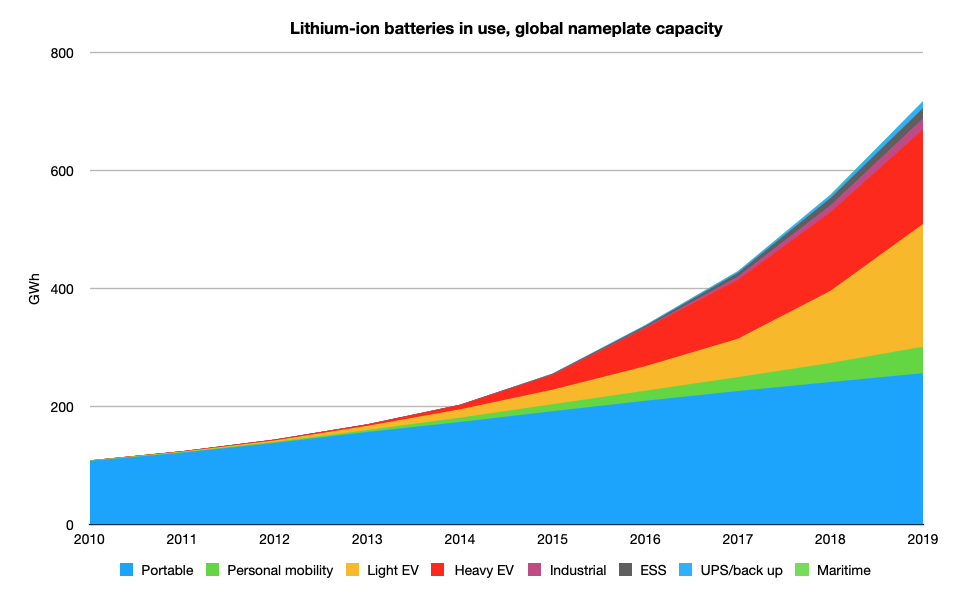
Decarbonising transportation is essential to meeting U.S. greenhouse gas reduction targets, as moving people and goods is the single largest direct source of climate-changing emissions. As a result, analysts are predicting a coming surge in electric vehicle sales.
For example, according to BloombergNEF, global electric passenger car sales will increase from 3.1 million in 2020 to 14 million in 2025. By 2040, BloombergNEF analysts say as much as 90 percent of all new passenger car sales will be electric. An AutoPacific survey in 2022 found that three in four American consumers view electric vehicles as the way of the future.
Those electric cars, trucks, buses and other vehicles need batteries. While other options are being considered, lithium-ion (Li-ion) batteries are the main technology to power these vehicles. However, putting tens of millions of new electric vehicles on the road every year will pose a critical challenge to the supply of materials.
“If we convert a significant portion of our fleet, we could have supply issues, especially cobalt, nickel and lithium,” said Tedd Lister, an INL research associate. He is also a member of a research team that has developed a new recycling technology for Li-ion batteries that is more efficient and environmentally friendly than current methods.
Contents
Tighter Recycling Loop
Battery recycling is vital because one solution to the looming supply problem would be a closed-loop arrangement, where batteries are processed at the end of their life to recover cobalt, lithium and other critical materials which can then be used to make new batteries.
Significant recycling is already taking place. In 2018, 20 companies worldwide recycled just under 100,000 tons of Li-ion batteries, about half of the global volume of batteries discarded that year. Material recovery may include direct recycling, pyrometallurgy and/or hydrometallurgy.
Direct recycling tries to use a tighter recycling loop and retain more production value. An important goal is the rejuvenation of the cathode material so that it can be directly reused in a battery of the same type. In practice, however, the value of this approach is limited because battery compositions change rapidly and Li-ion batteries are designed to last ten years or more. Another challenge is the need to segregate collected batteries by manufacturer and production time, as each manufacturer uses a unique cathode material.
Pyrometallurgical processes can accept different types of batteries, where high temperatures (above 700°C) are used in a furnace to melt the battery into an alloy. Hydrometallurgical refining using acids and other chemicals then separates and recovers cobalt, nickel and copper from the alloy, while the lithium is recovered from the waste slag. Due to the required temperatures, the recycling process can have a significant carbon footprint if fossil fuels provide the energy for melting.
One way to reduce greenhouse gas emissions from Li-ion battery recycling is to use only hydrometallurgy to leach materials. It often involves the use of sulfuric acid and hydrogen peroxide because the combination is very effective; reported yields for the target metals are over 90 percent when the leaching is performed at temperatures above 40°C. However, making the chemicals has significant negative environmental impacts and poses safety risks, as does their transportation and storage .
An Electrochemical Boost
As described in the peer-reviewed scientific journal Resources, Conservation and Recycling, an INL team explored a different approach using an electrically powered hydrometallurgical process. INL researchers developed an electrochemically assisted leaching method that continuously regenerates Fe2+ in small concentrations. The Fe2+ reacts with the cathode metals of the Li-ion battery to promote their extraction into the aqueous phase. The team achieved near-complete metal leaching from Li-ion battery “black mass” material recovered from shredded Li-ion batteries containing the active battery components.
The electrochemical boost from the leach process is an important part in achieving the goal of a greener recycling solution for Li-ion batteries.
“Electrochemistry is the transformation of electrical energy into chemical bonds or chemical bonds into electrical energy,” said Luis Diaz-Aldana, an electrochemical scientist and INL team member. “The vision we had is that we can use this electricity as a green reagent. So that it can replace a significant amount of chemicals.”
He added that the electricity could come from a carbon-free source, such as a solar panel, a wind farm, a hydroelectric plant or a nuclear power plant. This would reduce the total emissions from the new recycling process to an even greater extent compared to competing processes.
The process has been scaled up from the first proof-of-principle demonstration to a system that can handle more than 0.5 kg/day. From an industrial battery recycler, the team obtained metal oxide black mass consisting of the anode and cathode powder recovered from a mixture of different Li-ion batteries.
The black mass contained lithium, cobalt, manganese, nickel and aluminum in observed formulations, such as LiCoO2, LiMnxCoyO2, LiNixMnyCozO2, and LiNixCoxAlzO2. Along with these lithium-containing materials, more than 30 percent by weight in the black mass was nonmetals, including graphite from the anode and elsewhere, carbon material, and polymeric bits of battery separators.
The INL researchers placed the black mass on one side of the bipolar membrane in a sulfuric acid iron sulfate solution, along with a stirring magnet and stainless steel cathode mesh. They put water and a nickel anode on the other side of the membrane. They then operated the chamber at a cathode potential of -0.3 V, causing the cobalt, lithium, manganese and nickel to leak out of the cakes at greater than 96 percent efficiency, a near-total recovery of these critical materials from the shredded Li ion batteries . The copper was plated out on the electrode and the graphite also precipitated into a shape suitable for further processing.
This material extraction took place at room temperature, with an estimated electricity consumption of 232.3 kWh per tonne of black matter. The researchers calculated that using the electrochemical approach would reduce the cost of chemicals by as much as 84 percent compared to following the traditional sulfuric acid-hydrogen peroxide method. In addition to these cost savings, less use of chemicals also means less environmental impact from the production, storage, transportation and disposal of chemicals.
Overall, the reduction in chemical consumption and room temperature operation should save about 80 percent of the cost of chemicals and energy, according to an analysis by the researchers. Optimizing the process could make those savings even greater, both for operational and capital costs.
The electrochemical process has been patented and research into complementary processes continues, Lister said. For example, the output of the leach process is a critical material rich solution and the dissolved metals must be separated and converted into products suitable for manufacturing new cathodes. This is an area of active development where significant progress has been made towards the ultimate goal of a sustainable commercial recycling process for Li-ion batteries. “We have a complete package that we can show to someone,” he said.
This article was written by Hank Hogan, president, Hank Hogan Writing and Editorial, for Idaho National Laboratory (Idaho Falls, ID). For more information, visit here.
These properties make graphene a much sought-after material for companies trying to make better use of the material. Its highly conductive nature makes it suitable for application in solar panels, where it can increase the efficiency of the panel up to 60% from the current 25%.
What percent of lithium-ion batteries are recycled?
The industry is well known for pursuing a closed system for battery recycling – today 99% of lead-acid batteries in the United States are recycled. But according to the DOE, only about 5% of lithium-ion batteries are currently recycled.
How much lithium is actually recycled? Despite the smaller supply of lithium, a study earlier this year in the Journal of the Indian Institute of Science found that less than 1 percent of lithium-ion batteries are recycled in the US and EU, compared to 99 percent of lead-acid batteries. those are most commonly used in gas and power grid vehicles.
Why only less than 5% of the Li-ion batteries were recycled?
That success story puts the world on track to generate a ton of millions of tons of used Li-ion batteries that could end up in the trash. The batteries are valuable and recyclable, but due to technical, economic and other factors, less than 5% is recycled today.
Can lithium-ion batteries be fully recycled?
Li-ion batteries, or batteries contained in electronic devices, should therefore be recycled at certified battery electronics recyclers who accept batteries instead of being thrown away in the trash or placed in the municipal recycling bins.
What is the largest problem with lithium-ion batteries?
Environmental Impact While safe for landfills, the physical extraction of lithium and the production of lithium ion are both incredibly labor intensive. In addition, most batteries are not recycled properly, making the environmental impact costly.
Why is battery recycling difficult?
How many lithium-ion batteries are recycled each year?
While it is often claimed that only 5% of lithium-ion batteries are recycled, a review of research into second-life and recycling lithium-ion batteries suggests that this is a gross understatement. A new study found that nearly 100,000 tons of waste batteries were recycled last year — about half of what reached end-of-life.
Why are lithium-ion batteries not being recycled?
But the recycling of lithium-ion batteries has only recently made a commercial advance. Battery manufacturers have been hesitant about concerns that recycled products may be of lower quality than products made from newly mined minerals, potentially resulting in shorter battery life or damage to the battery’s interior.
How much lithium is recycled per year?
Yole Développement (Yole) expects approximately 705,000 tons of discarded Li-ion batteries by 2025. This figure should reach 9 million tons per year by 2040. The total market for recycling Li-ion batteries was approximately 93,800 tons in 2019. analysts announce a CAGR of 30% for 2019-2025, to reach 459,369 tons at the end of the period.
What percentage of lithium batteries are recyclable?
On average, about 50% of a lithium-ion battery can be recycled effectively.
Are lithium-ion batteries 100% recyclable?
Yes, lithium-ion batteries are recyclable, but the process is a bit complicated. This may be why you are struggling to find a recycling center that handles this type of waste. The first challenge for lithium recycling is that you can’t handle those batteries like any other electronic waste.
Are batteries 100 percent recyclable?
Lead-acid or lead-acid batteries are distinguished by a recycling rate of nearly 100% in North America and Europe. Relatively simple, the lead-acid battery recycling process is also cost-effective, as recovered lead can be used in new batteries.
Can lithium-ion batteries be fully recycled?
Li-ion batteries, or batteries contained in electronic devices, should therefore be recycled at certified battery electronics recyclers who accept batteries instead of being thrown away in the trash or placed in the municipal recycling bins.
Why are lithium batteries not recyclable?
If current trends for handling these used batteries hold up, most of those batteries could end up in landfills, even though Li-ion batteries can be recycled. These popular power packs contain valuable metals and other materials that can be recovered, processed and reused.
Who makes quantum glass battery?
Quantum Glass Battery Stock: QuantumScape (QS) The company’s testing showed that its single-layer battery cells can effectively charge to 80% of a cell’s capacity within 15 minutes. In addition, it partnered with German automaker Volkswagen (OTCMKTS:VWAGY), which hopes to use its cells by 2025.
Why did QuantumScape stock jump? The sudden jump in the share price can be attributed to an article published by the German business monthly Manager Magazin that sparked speculation about a possible partnership between QuantumScape and a luxury car manufacturer.
What stock has the Forever battery?
Some of you are familiar with QuantumScape stocks. The company is working on a groundbreaking ‘forever battery technology’ that could literally change almost everything about everything.
Is the forever battery A hoax?
And yes, it could enable electric cars to travel thousands of miles on a single charge. That’s why insiders have labeled SSBs as ‘batteries forever’. Therefore, they are the critical technology needed to propel the EV revolution to the next stage of supercharged growth.
What company is making the Forever battery?
Solid-state batteries are the ‘forever battery’ technology that QuantumScape is developing. In fact, QuantumScape is pioneering a new class of solid-state batteries to make the world infinitely more productive.
Is freyr stock a buy?
FREYR Battery’s analyst consensus is a ‘Moderate Buy’. This is based on the assessments of 3 Wall Streets analysts.
What is the best quantum battery stock?
| Company | Market capitalization |
|---|---|
| Quantumscape (NYSE:QS) | $6 billion |
| Toyota Motor Corporation (NYSE:TM) | $222.6 billion |
| Solid Power (NASDAQ:SLDP) | $1.3 billion |
What company is behind the Forever battery?
Solid-state batteries are the ‘forever battery’ technology that QuantumScape is developing. In fact, QuantumScape is pioneering a new class of solid-state batteries to make the world infinitely more productive.
Which battery stock is best?
Best EV Battery Stocks to Invest in
- Panasonic Corporation (OTC:PCRFY) Number of hedge fund holders: N/A. †
- Contemporary Amperex Technology Co., Limited (SHE:300750) Number of hedge fund holders: N/A. †
- Solid Power Inc. (NASDAQ:SLDP) …
- Romeo Power, Inc. (NYSE:RMO) …
- Lithium Americas Corp. (NYSE:LAC)
What stock is the quantum glass battery?
Quantum Glass Battery Stocks: QuantumScape (QS) QuantumScape is arguably the OG in solid-state battery development. The company’s tests showed that the single-layer battery cells can effectively charge up to 80% of a cell’s capacity within 15 minutes.
What company is making the quantum glass battery?
Quantum Glass Battery Stocks: QuantumScape (QS) QuantumScape is arguably the OG in solid-state battery development. The company’s tests showed that the single-layer battery cells can effectively charge up to 80% of a cell’s capacity within 15 minutes.
What is the best quantum battery stock?
The current leader in the race to perfect the quantum glass battery is South Korean conglomerate Samsung (SSNLF). The company recently announced a major breakthrough in its efforts to develop a functional solid-state battery for use in electric vehicles.
What company is making the Forever battery?
Solid-state batteries are the ‘forever battery’ technology that QuantumScape is developing. In fact, QuantumScape is pioneering a new class of solid-state batteries to make the world infinitely more productive.
What is the name of the stock for the Forever battery?
At the date of publication, Luke Lango had no (direct or indirect) positions in the securities referred to in this article. The post QuantumScape is a ‘forever battery’ stock with millionaire potential ��âš¡ appeared first on InvestorPlace.
Is there anything better than lithium-ion batteries?
Fluoride batteries have the potential to last eight times longer than lithium batteries, but that’s easier said than done. That’s because fluoride is an anion, or negatively charged ion, which is the magic behind its high energy density, but also the reason it’s reactive and difficult to stabilize.
What is the most promising battery technology? 5 new battery technologies that will change the future
- NanoBolt lithium-tungsten batteries. Working on battery anode materials, researchers at N1 Technologies, Inc.
- Zinc manganese oxide batteries. †
- Organosilicon electrolyte batteries. †
- Gold nanowire gel electrolyte batteries. †
- TankTwo String Cell™ batteries.
What will replace lithium-ion batteries?
One of the most promising alternatives is the use of sodium-ion (Na-ion) batteries instead of lithium-ion batteries. Na-ion batteries have several advantages over the traditional Li-ion batteries in different end uses. Lithium and sodium are both alkali metals and are next to each other in the periodic table.
What will Tesla use instead of lithium?
Tesla’s first battery option is Nickel Cobalt Aluminum (NCA). The company began using NCA battery chemistry years ago in the form of 18650 cells, which were produced by Panasonic for the Model S and Model X.
What metal will replace lithium in batteries?
New sodium metal anode for rechargeable batteries could replace lithium. Scientists at the University of Texas at Austin have developed a new sodium-based battery material that offers useful stability and can be charged as quickly as a standard lithium-ion battery.
What is a good replacement for lithium?
Sodium-sulfur batteries are another alternative to lithium and have already been widely used in locations around the world. In February 2019, Abu Dhabi installed the world’s largest battery using sodium-sulfur battery cells.
Is there anything better than lithium for bipolar?
Conclusions: These results suggest that olanzapine was significantly more effective than lithium in preventing manic and mixed episode relapse/recurrence in patients acutely stabilized with concomitant treatment with olanzapine and lithium. Both agents were comparable in preventing relapse/recurrence of depression.
What drug is a good replacement for lithium?
Second-generation mood-stabilizing anticonvulsants carbamazepine and valproate are now widely used as an alternative or supplement to lithium.
Are graphene batteries better than lithium?
Graphene batteries have been proven to have a much higher capacity on average than lithium-ion batteries, even at smaller sizes. Lithium-ion batteries can store up to 180 Wh per kilogram, while graphene can store up to 1,000 Wh per kilogram, making it a much more space-saving store of energy.
Do graphene batteries last longer?
Graphene is highly conductive, allowing electricity to flow, and rigid, so it helps the lithium keep its shape, extending battery life.
Is there a better battery than lithium?
Batteries made of magnesium metal could have higher energy density, greater stability and lower cost than current lithium-ion cells, scientists say in one study. Magnesium has another advantage. Each magnesium atom releases two electrons during the battery’s discharge phase, compared to one electron for lithium.
Will graphene batteries replace lithium?
The traditional lithium-ion battery in electric cars could soon be replaced by a new generation made of graphene. This material has many qualities. In particular, it should be able to charge the battery much faster than it is today.
What company is making a forever battery?
Solid-state batteries are the “forever battery” technology that QuantumScape is developing. In fact, QuantumScape is pioneering a new class of solid-state batteries to make the world infinitely more productive.
Who is the forever battery Stock? QuantumScape is a Forever Battery Stock with Millionaire Potential – Imagine you have a $10,000 investment that has grown to over $46 million dollars.
What is the price of Forever battery Stock?
| Back Close | 8.27 |
|---|---|
| To ask | 8.99×1100 |
| Day range | 8.73 – 8.49 |
| 52 weeks range | 6.42 – 14.37 |
| Volume | 852.227 |
What small company is making the Forever battery?
Solid-state batteries are the ‘forever battery’ technology that QuantumScape is developing. In fact, QuantumScape is pioneering a new class of solid-state batteries to make the world infinitely more productive.
Is Frey stock a good buy?
Out of 4 analysts, 2 (50%) recommend FREY as a strong buy, 1 (25%) recommend FREY as a buy, 1 (25%) recommend FREY as a hold, 0 (0%) recommend FREY as a sale, and 0 (0%) recommends FREY as a strong sale. What is FREY’s earnings growth forecast for 2022-2024?
What is the 3 dollar forever battery stock?
Listen to Luke’s latest podcast on QuantumScape Instead, that title is reserved for a small, completely unheard of solid-state battery manufacturer whose stock currently trades for less than $3. Less than $3… and this company could change the world in the next decade.
What company is making the 12 million mile battery?
Two years ago, Tesla patented Dahn’s million-mile battery, and CEO Elon Musk said he would deploy the long-life battery in 2020. That year has passed without Musk executing these plans.
What company is making the Forever battery?
Solid-state batteries are the ‘forever battery’ technology that QuantumScape is developing. In fact, QuantumScape is pioneering a new class of solid-state batteries to make the world infinitely more productive.
What company is making the new super battery?
Skeleton Technologies partnered with the Karlsruhe Institute of Technology to complete the development of the SuperBattery.
Who makes the million-mile battery for Tesla?
The battery research team around Jeff Dahn continues to work on the million-mile battery. As Tesla’s battery researcher explained at an online conference, the actual goal isn’t to drive an electric car for 1.6 million miles, but to be able to use the battery in V2G applications.

Comments are closed.