


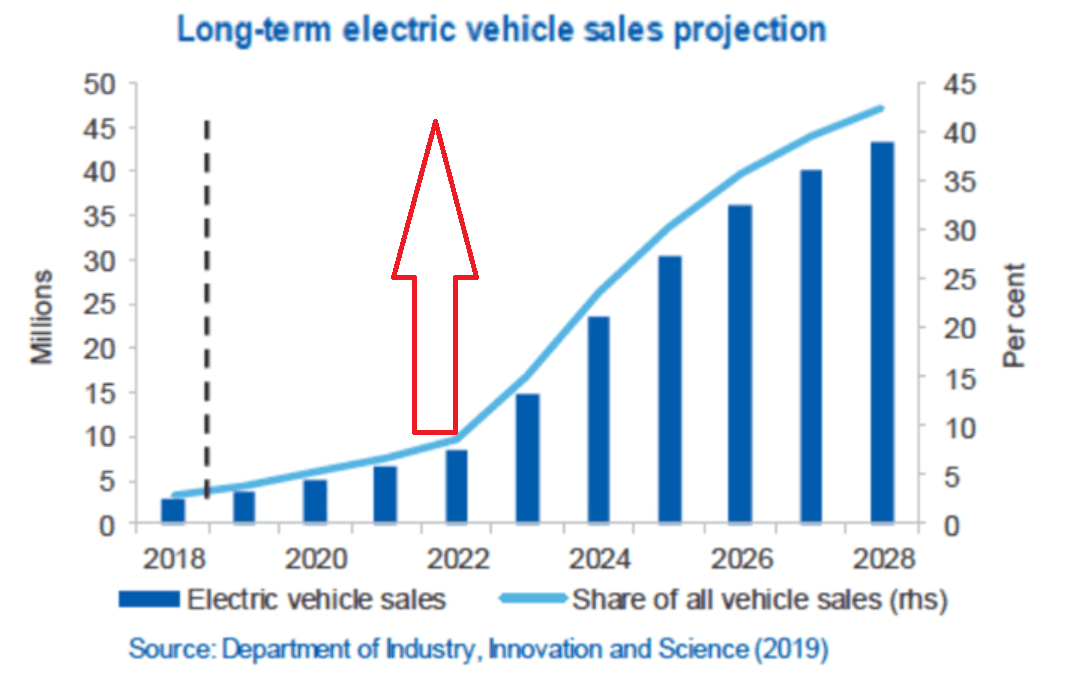
It remains to be seen when and how this conception will come true. But in the meantime, Li-Cycle has ample funding to carry it out. Glencore mining conglomerate invested $ 200 million in May, and Koch Strategic Platforms invested $ 100 million last September, both as convertible banknotes.
Ascend Elements: Turn old cathodes into new cathodes
Michael O’Kronley knew he could get more out of old batteries than mixed metal slag from pyrometallurgy. And conventional hydrometallurgy wanted to get more of the raw materials that it recovers from the crushed battery parts.
“We want to make the most valuable material possible out of spent lithium-ion batteries,” said O’Kronley, who runs Ascend Elements, a closed-end recycling company founded in 2015.
The most expensive part of a new battery is the cathode. Cathodes are currently processed in mining and lithium and metals such as nickel, manganese and cobalt. But an old battery has all the necessary components. It’s just a matter of getting them out and returning them in a fresh and usable form.
Scientists at Ascend talked about traditional hydrometallurgy and created a process they call the “hydro-cathode”. They reduce the batteries and put them in solution. Instead of extracting individual metals, they remove impurities from the liquid and leave only the cathode components in a purely atomic state. Then scientists can adjust the metal ratio of the cathode material to what the customer is looking for. They precipitate nickel manganese cobalt hydroxide, the precursor of the cathode. Addition of lithium gives the cathode a new active material.
This process yields cheaper battery materials from the ground than mining and refining, O’Kronley said. But Ascend still needs to increase its factory capacity and prove to customers that its materials are as good as regular batteries.
A study published in the journal Joule last year had a boost in that effort. The researchers, including scientists at Argonne National Lab, tested Ascend’s materials and “the recycled material exceeds the commercially available equivalent.”
Low cost is a competitive advantage in the battery market. But recycled cathodes have even greater benefits in terms of environmental impact. They help prevent carbon-intensive mining and shipping, and the recycling process itself can be run on clean electricity.
“Our carbon footprint … is 90 percent smaller than cathode material from virgin sources,” O’Kronley said. “It will drastically change the CO2 footprint equation of a new EV, which is extremely important for the industry going forward.”
Ascend has performed at pilot plants in Massachusetts and Michigan in recent years. A commercial recycling plant is currently under construction in Covington, Georgia, and will open this year. This facility will split the depleted batteries and remove lithium, cobalt and nickel salts from the mass. A second factory, which will be networked in early 2024, will take metals and turn them into fully active cathode materials. The company raised $ 20 million in a Series B funding round in 2021 and raised another $ 70 million that year to fund those efforts.
There are many proven technological improvements in battery recycling, O’Kronley said. The problem is that low recycling capacity has been built.
“As we build these gigabytes, we need to build gigabyte recycling plants along with that,” he said.
Redwood Materials: Use stored energy to power the recycling
Old batteries usually end up in recycling facilities with some energy stored in them. Then, many recyclers spend time and money emptying their cargo to get the materials out safely.
Redwood Materials, a well-funded startup run by Tesla co-founder and CTO JB Straubel, believes this is a waste. A Reno-based Nevada company has found a way to convert stored electricity into heat for a low-temperature calcification process that removes electrolyte from cells in old batteries.
This and other proprietary hydrometallurgy techniques extract more than 95 percent of battery materials, said spokeswoman Alexis Georgeson. Today, the company converts these materials into “intermediate batteries,” the metals that go into the production of new batteries. But the plan is to make new copper foil and eventually home-made anode and cathode materials.
“We’re a battery company, and we’re using recycled content to help make battery materials as sustainable as possible,” Georgeson said.
Energy is one of the main inputs for a recycling operation. By harnessing the same battery power, the energy bill is reduced. Redwood supplies the rest of its operation with renewable electricity, Georgeson said.
KULR: Make it safe and cheap to transport old batteries
Recycling costs start accumulating before old EV batteries arrive at a facility.
Used Lithium-ion batteries are considered a hazardous material by the U.S. Department of Transportation, primarily because spent batteries can catch fire. This designation establishes special protocols: trains and planes cannot be transported, and truck drivers must be specially trained to handle them. This makes it more expensive to move old electric vehicle batteries to a central recycling site.
KULR Technology Group helps shipping companies to overcome these limitations while continuing to comply with the law. The startup received a special permit from the Department of Transportation last year for its lightweight fire-fighting wallet. KULR designed a carbon-fiber-cooled liquid for NASA to allow astronauts to store lithium-ion laptop batteries without a fire in outer space.
It is now available for use with up to 2.1 kilowatt-hour ground batteries. This is a small part of the battery of an electric vehicle, but it is useful for batteries used in consumer electronics and micromobility devices (e.g., scooters and electric bicycles).
“Domino’s Pizza is like a case in point, but instead of keeping [the batteries] warm, it keeps them cold,” said Michael Mo, CEO.
The company already helps battery manufacturers and recyclers like Retriev to support the delivery of end-of-life units. The fireproof housing reduces the cost of transportation, both because it avoids the need for specialized training and because it is more efficient than the status quo delivery methods. Today, the depleted batteries are shipped in a UL-certified cardboard box with fireproof and thermal insulation, a traditional product designed for previous generation of battery technologies, Mok explained.
“It doesn’t matter if the cardboard is fire filtered, it won’t cut” in a lithium-ion fire, he said.
KULR is working to increase the capacity of its envelopes. If it can achieve a 10-kilowatt-hour certification, it is feasible to distribute the entire EV package in modules that come in a fireproof case. For now, the company is looking for smaller battery packs that are already in circulation.
Solarcycle is proud to support the Canary Media Recycling Renewables series. Solarcycle offers owners of solar assets a low-cost, environmentally friendly and comprehensive process for the removal of solar systems. We extract valuable metals such as silver, silicon and aluminum and have the technology to recycle 95% of the panels currently in use. Follow Solarcycle on LinkedIn to address this important challenge on a gigabyte scale.

Comments are closed.