


A joint research team from Tohoku University and the University of California, Los Angeles (UCLA) has made significant progress for high-voltage metal-free lithium-ion batteries that use a small organic molecule, croconic acid. The breakthrough is moving us closer to realizing metal-free, high-energy, and cheap lithium-ion batteries.
Unlike conventional lithium-ion batteries, which rely on rare-earth materials such as cobalt and lithium, organic batteries utilize abundant natural elements such as carbon, hydrogen, nitrogen, and oxygen. In addition, organic batteries have greater theoretical capabilities than conventional lithium-ion batteries because the use of organic materials becomes mild. Most organic batteries are reported to date, however, having a relatively low working voltage (1-3V). Increasing the organic battery voltage will result in a higher energy density battery.
Itaru Honma, professor of chemistry at Tohoku University’s Institute of Multidisciplinary Research for Advanced Materials, Hiroaki Kobayashi, assistant professor of chemistry at Tohoku University, and Yuto Katsuyama, a graduate student at UCLA, found that croconic acid, when used as lithium. Ion battery cathode material, maintains a strong working voltage of around 4 V.
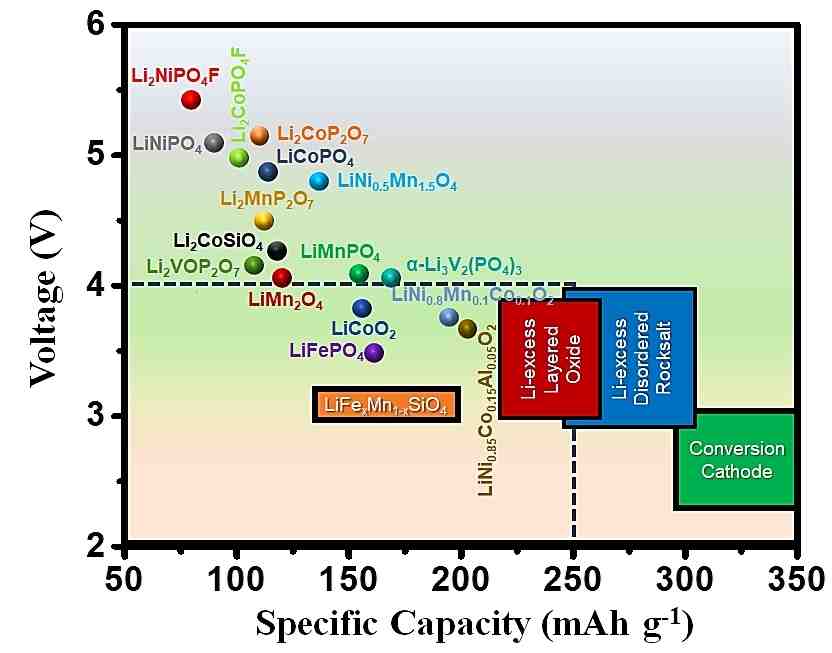
Croconic acid has five carbon atoms bonded in a pentagonal shape, and each carbon is bound to oxygen. It also has a higher theoretical capacity of 638.6 mAh / g, which is higher than the conventional lithium-ion battery cathode material (LiCoO2 ~ 140 mAh / g). “We studied the electrochemical behavior of croconic acid in the high voltage range above 3 V using theoretical calculations and electrochemical experiments,” Kobayashi said. “We found that croconic acid stores lithium ions at roughly 4 V, giving a very high theoretical energy density of 1949 Wh / kg, which is larger than most inorganic and organic lithium-ion batteries.”
Although theoretical capacity was not achieved in this study, these optimistic researchers could be enhanced by the development of stable electrolytes at high voltage and chemical modifications to croconic acid. Since most electrolytes cannot stand to such croconic acid working voltage, the development of new electrolytes is crucial. In addition, the structure of small organic molecules, including croconic acid, can be easily altered. Appropriate structural modifications can balance the molecule, leading to greater capacity and reversibility.
Materials provided by Tohoku University. Note: Content can be edited for style and length.

Comments are closed.